Drinking Water Treatment Technology: Types, Benefits, and Solutions from Sinowater
Understanding Drinking Water Treatment Technology
Water is a fundamental necessity for human life and various industrial activities. Simply having access to water is not enough; its quality must also meet the required usage standards.
Water from wells, rivers, or other sources may contain sediments, dissolved minerals, organic matter, and microorganisms. These components need to be analyzed before determining the appropriate treatment method.
Drinking water treatment technology provides solutions to improve water quality through various filtration and purification processes.
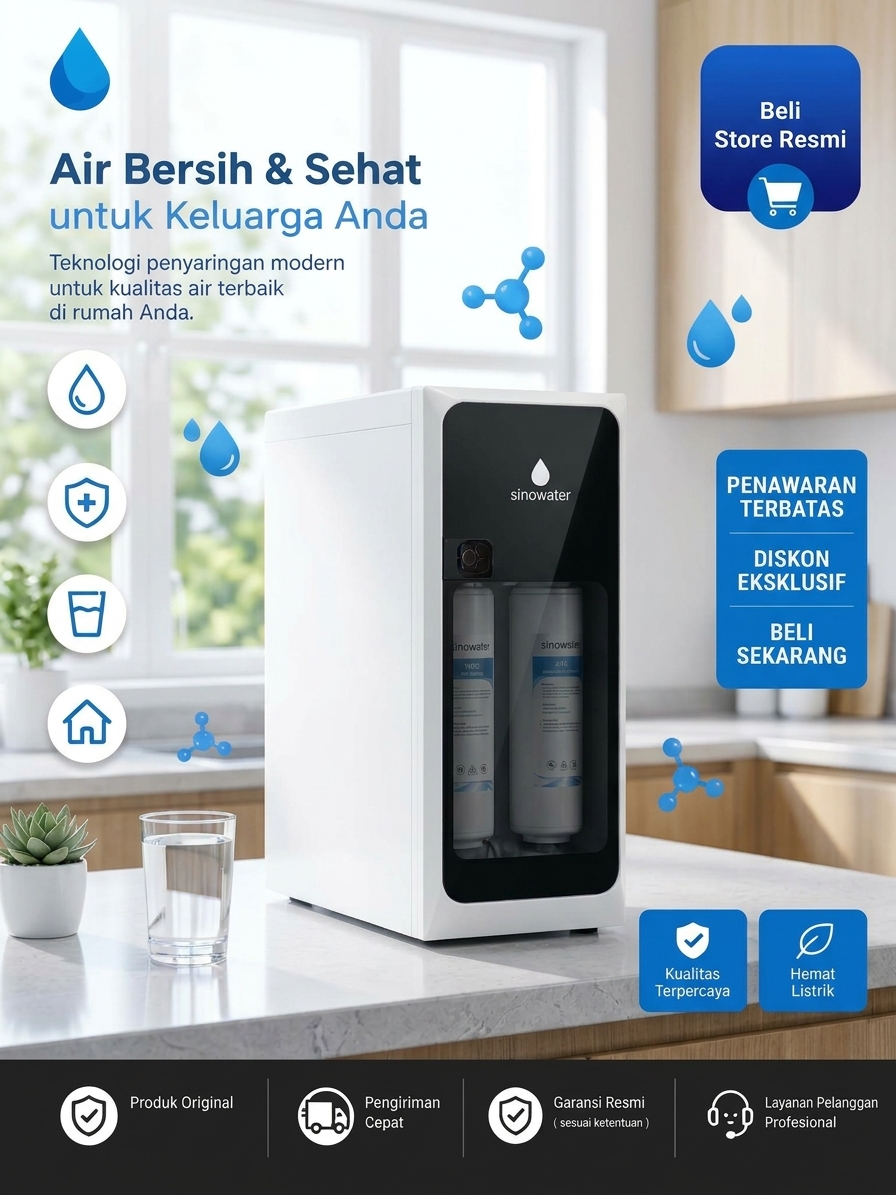
PT Sinowater International Solution offers a range of products and systems for water treatment to meet household, commercial, and industrial needs.
5 Commonly Used Types of Water Treatment Technology
1. Sediment Filter for Removing Dirt Particles
Sediment filters are one of the initial stages in a water treatment system. This technology helps reduce suspended particles such as sand, silt, and dirt.
A commonly used medium is the PP Sediment Filter.
Benefits include:
- Helps reduce solid particles.
- Protects downstream filtration components.
- Supports multi-stage filtration processes.
- Ideal for use as a pre-filter.
2. Activated Carbon Filter for Reducing Odor and Chlorine
Activated carbon has a porous structure that enables it to adsorb various specific compounds.
This medium is widely used to help reduce odor, taste issues, and chlorine in water.
The two most common types are:
- GAC (Granular Activated Carbon).
- CTO (Carbon Block).
The choice of activated carbon type should be tailored to the specific needs and characteristics of the raw water.
3. Reverse Osmosis (RO) for Water Purification
Reverse osmosis is a water treatment technology that uses a semi-permeable membrane.
This process works by applying pressure to force water through the membrane, thereby reducing dissolved substances.
Applications include:
- Drinking water treatment.
- Industrial water needs.
- Production of water with lower dissolved mineral content.
- Treatment of water requiring specific quality standards.
RO system capacity can be customized to suit requirements, ranging from household to industrial scales.
4. Ultraviolet (UV) for Water Disinfection
Ultraviolet technology uses UV light to help inactivate microorganisms in water.
UV systems can be used as a disinfection step following appropriate filtration processes.
Advantages include:
- Disinfection process without chemical residues from UV treatment.
- Does not significantly alter the mineral composition of the water.
- Can be integrated with other water treatment systems.
The effectiveness of disinfection is influenced by UV intensity, exposure time, water clarity, and equipment condition.
5. FRP Tank for Water Filtration Systems
FRP (Fiberglass Reinforced Plastic) tanks are composite fiberglass vessels widely used as containers for filter media in water treatment systems.
FRP tanks can be used with various media such as silica sand, activated carbon, and other water treatment media according to system design.
These components are extensively applied in household, commercial, and industrial water treatment installations.
Typical Stages of a Water Treatment System
Water treatment systems typically involve several stages tailored to the quality of the raw water.
Here is an example sequence of water treatment processes:
- Water Intake: Collection of water from the source.
- Pre-Filtration: Initial filtration to remove coarse particles.
- Sediment Filtration: Reduction of suspended particles.
- Carbon Filtration: Assistance in reducing chlorine and odor-causing compounds.
- Membrane Filtration: Use of membranes such as RO when necessary.
- UV Disinfection: Disinfection process if required.
- Water Storage: Storage of treated water in suitable tanks.
Not every installation requires all these stages. System design must consider raw water analysis results and targeted water quality standards.
Differences Between Household and Industrial Water Treatment
The requirements for household and industrial water treatment differ significantly.
| Aspect | Household | Industrial |
|---|---|---|
| Capacity | Relatively small | Medium to large |
| Purpose | Daily activities | Production processes |
| System | Household filters and RO systems | Water Treatment Plants |
| Design | Simpler | Based on technical requirements |
| Maintenance | Regular | Scheduled and measurable |
For industrial applications, selecting equipment requires consideration of water flow rate, operating pressure, raw water quality, treated water requirements, and operational costs.
Why Choose Sinowater’s Water Treatment Solutions?
PT Sinowater International Solution offers a wide range of products and components for water treatment system needs.
Product portfolio includes:
- Reverse Osmosis (RO) Machines.
- PP Sediment Filters.
- CTO and GAC Carbon Filters.
- FRP Tanks.
- UV Water Sterilizers.
- Household Water Treatment Systems.
- Industrial Water Treatment Machines.
- Seawater Desalination Systems.
With this diverse product selection, Sinowater supports water treatment needs based on customer capacity and source water characteristics.
Tips for Choosing the Right Water Treatment Machine
Before purchasing a water treatment machine, consider the following factors:
- Identify the raw water source.
- Conduct water quality testing.
- Determine the required daily water capacity.
- Choose filtration technology based on contaminant types.
- Consider electricity consumption and operational costs.
- Ensure availability of spare parts and maintenance services.
Proper planning can help improve the long-term efficiency of your water treatment system.
Consult Sinowater for Your Water Treatment Needs
Do you need a household water filter, a Reverse Osmosis machine, or an industrial water treatment system?
PT Sinowater International Solution provides a variety of products and technological solutions for household, commercial, and industrial water treatment needs.
Contact the Sinowater team for product information and consultation on selecting a water treatment system tailored to your requirements.
Official Website: https://www.sinowatersolution.com/id/
FAQ on Water Treatment Technology
1. What is water treatment technology?
Water treatment technology refers to methods or processes used to reduce contaminants and improve water quality according to its intended use.
2. What is the difference between a regular water filter and Reverse Osmosis?
Conventional filters use specific filtering media, while RO uses semi-permeable membranes to reduce various dissolved substances.
3. Can activated carbon eliminate water odors?
Activated carbon can help reduce odor-causing compounds through adsorption.
4. What is the function of UV in water treatment?
UV is used to help inactivate microorganisms through ultraviolet exposure.
5. How do you determine the capacity of a water treatment machine?
Capacity is determined based on daily water needs, peak flow rates, source water quality, and target quality of the treated water.
Supporting Keywords:
- Water Treatment Systems
- Water Treatment Machines
- Industrial Water Filters
- Water Filtration Technology
- Reverse Osmosis Machines
- Household Water Treatment
- Water Treatment System